The Truth About Dentures and Bone Loss
By Mandy Davidson on 2/2/2026
The menu is handed to you at the restaurant, and your eyes automatically scan for the “safe” foods before you even look at the prices or the specials. You aren’t looking for what sounds delicious; you are looking for what you can physically manage to eat without embarrassment or pain. This subconscious calculation is the daily reality for millions of Canadians living with tooth loss, a condition that affects far more than just the aesthetics of a smile.
While the immediate shock of losing a tooth often centers on the visible gap, the physiological cascade that begins the moment a tooth is extracted is far more complex and consequential than most patients realize. When you are faced with the decision of how to restore your dental function, the terminology can feel overwhelming and the price tags can be shocking.
The debate between traditional dentures and dental implants is often framed as a simple choice between a “budget” option and a “luxury” option, but that simplification does a disservice to the biology involved. These are not merely two different products on a shelf; they are two fundamentally different approaches to managing the anatomy of the human jaw. One approach focuses on replacing the visible crown of the tooth, while the other focuses on replacing the biological anchor that keeps your jawbone alive.
To make a decision that you will be happy with five, ten, or twenty years from now, you need to look beyond the brochure and understand the mechanics of your own mouth. Dr. Lok has spent over four decades restoring smiles in Toronto, and we have seen exactly how these decisions play out over the long term for patients of every age and background.
The Silent Crisis: Alveolar Ridge Resorption
To understand why a dentist might push for an implant over a denture, you first have to understand a biological concept called Wolff’s Law. This physiological principle states that bone in a healthy person or animal will adapt to the loads under which it is placed; essentially, bone requires physical stress and stimulation to maintain its density and volume. Your natural tooth roots provide this stimulation every single time you chew, sending signals to the jawbone (the alveolar ridge) that it is still needed to support the teeth.
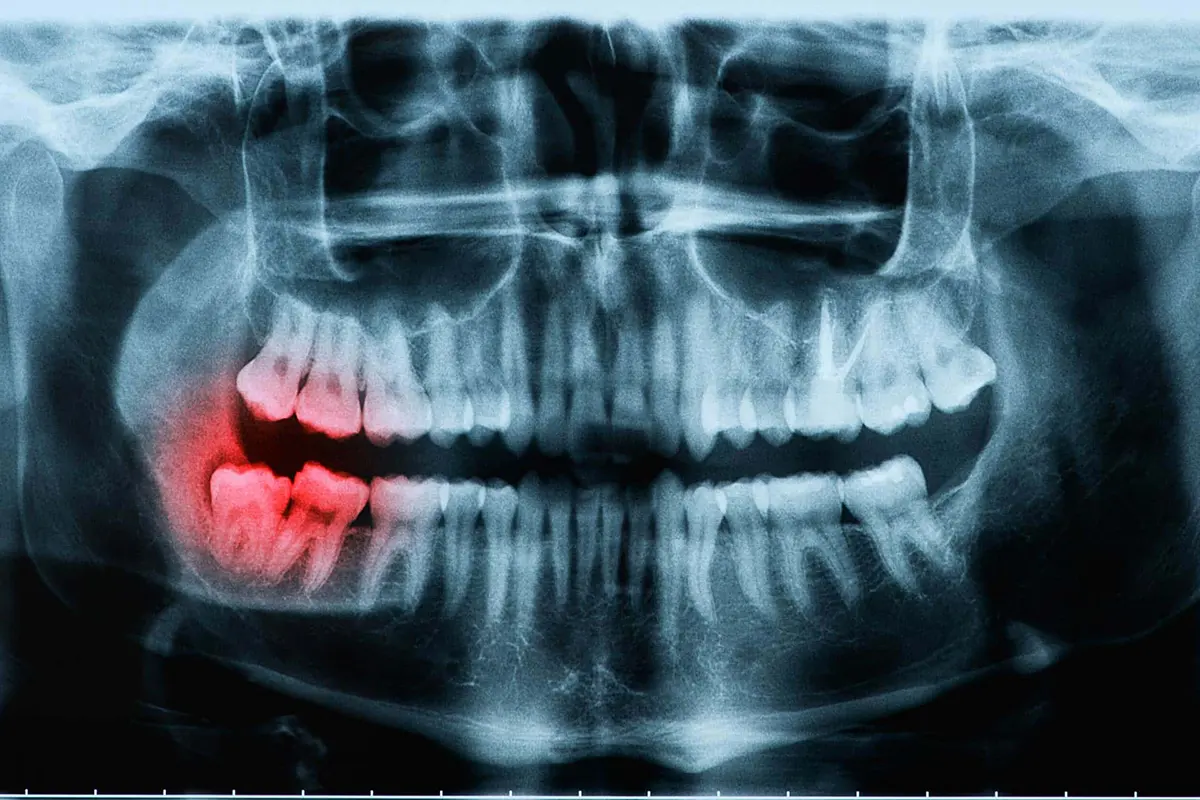
When a tooth is removed, that signaling mechanism is instantly severed, and the body initiates a process of “cleaning house.” The body perceives the bone in that area as unnecessary tissue that is consuming energy, so it begins to resorb, or dissolve, the bone to use those minerals elsewhere. According to research published by the Journal of Indian Prosthodontic Society, the most rapid decline in bone structure occurs within the first year after tooth loss, with some patients losing up to 25% of their bone width in those first twelve months alone. This is why regular dental check-ups are so critical—catching problems early can prevent tooth loss altogether.
This is the critical flaw of traditional dentures that few people talk about until they are already wearing them. Because a denture sits on top of the gum tissue and does not penetrate the bone, it provides absolutely no stimulation to the underlying jaw structure. In fact, the pressure of the denture base compressing the gums can actually accelerate the rate of bone loss in some cases.
Over ten or twenty years, this leads to the “collapsed” facial look often associated with old age: the chin moves closer to the nose, the lips roll inward, and the skin around the mouth wrinkles prematurely because the skeletal support structure has literally melted away.
The Physics of Chewing: A Question of Force
Beyond the long-term bone health, the most immediate difference between these two options is the sheer physics of eating. Natural teeth are anchored into the skull with a periodontal ligament that acts as a shock absorber, allowing the average human to exert roughly 200 to 250 pounds of force per square inch (PSI) while chewing. This force is what allows you to pulverize a raw carrot, tear through a steak, or crunch into an almond without a second thought.
Traditional dentures drastically alter this mathematical equation because they are floating appliances held in place by suction (for the upper jaw) or gravity and muscle control (for the lower jaw). Even a well-fitted denture sitting on healthy gums can only generate about 20% to 25% of the bite force of natural teeth, roughly 50 PSI. This massive reduction in power forces a change in dietary habits that can have downstream effects on your general health and nutrition.
When you cannot chew fibrous vegetables or tough proteins effectively, you are more likely to shift your diet toward softer, processed foods that are higher in carbohydrates and lower in nutritional value. Studies in the Journal of Prosthetic Dentistry have linked compromised dental function in the elderly to lower intake of protein and fiber, which in turn correlates with higher risks of systemic issues like gastrointestinal disorders. Our guide on diet and dental health explores this connection in greater detail.
When we talk about “restoring teeth,” we aren’t just talking about the smile; we are talking about restoring the machinery of the digestive system.
The Denture Reality: Skill, Not Just A Product
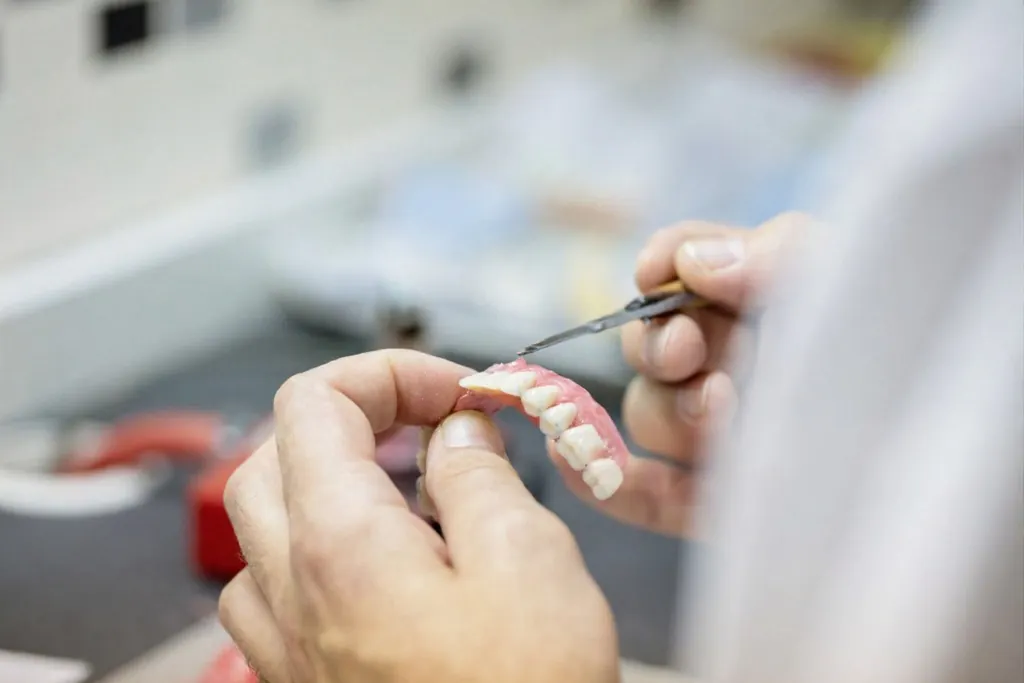
If you choose traditional dentures, it is important to reframe your expectations: you are not getting “new teeth,” you are getting a prosthetic device that requires a learned skill set to use. Just as someone with a prosthetic leg must learn to walk again, a denture wearer must learn to eat and speak again, and this learning curve can be steep and frustrating.

The upper denture usually covers the entire roof of the mouth (the palate) to create a vacuum seal for retention. While this provides stability, the palate contains thousands of taste buds and texture sensors that play a huge role in the enjoyment of food. Many new denture wearers report that food tastes bland or that they struggle to gauge the temperature of what they are eating or drinking, which diminishes the sensory pleasure of meals.
The lower denture presents an even greater challenge because it has no suction to hold it in place and must contend with the constant movement of the tongue. It effectively floats on the lower ridge, and patients must train the muscles of their cheeks and tongue to subconsciously hold the appliance down while speaking or chewing. This creates a psychological burden known as “prosthetic anxiety”—the constant, low-level fear that the teeth will slip, click, or fall out during a social interaction.
The Implant Alternative: Biological Mimicry
Dental implants are currently the only restorative option in dentistry that addresses the root cause of the problem rather than just the cosmetic symptom. An implant is a medical-grade titanium post that is surgically inserted directly into the jawbone, where it undergoes a process called osseointegration. This term, coined by Professor Per-Ingvar Brånemark, describes the structural and functional connection between living bone and the surface of a load-bearing artificial implant.
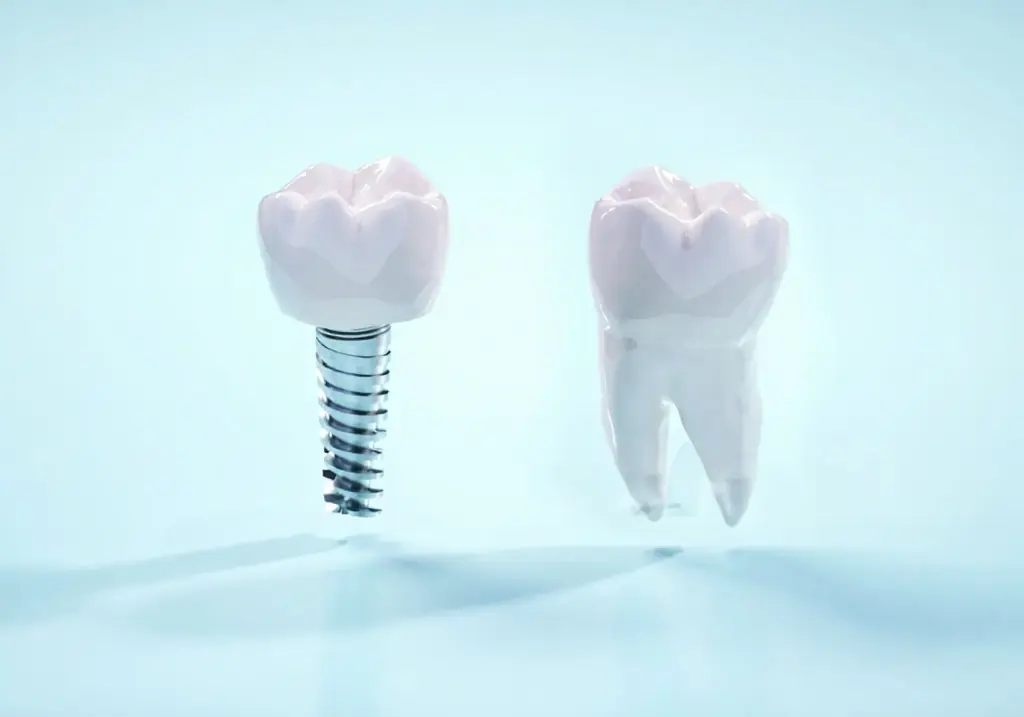
Over a healing period of three to six months, your bone cells attach themselves to the titanium surface, locking the implant in place as if it were a natural part of your skeleton. Once this fusion is complete, the implant stimulates the bone just like a natural tooth root, halting the resorption process described earlier and preserving your facial structure.
Because the implant is fused to the bone, it restores nearly 100% of your natural bite force, allowing you to eat whatever you want without fear of movement. However, this biological superiority comes with a prerequisite: you must have enough bone left to support the implant. This is why timing is so critical in restorative dentistry; waiting five years to address a missing tooth often means the bone has receded so much that you now require expensive bone grafting procedures before an implant can even be placed.
The “wait and see” approach is often the most expensive strategy of all because it allows the foundation to crumble while you wait. As we discuss in our article about the high price of dental fear, delaying treatment almost always costs more in the long run.
The Financial Analysis: Sticker Shock vs. Long-Term Value
We need to have an honest conversation about money because the cost difference between dentures and implants is substantial. A full set of dentures might cost a few thousand dollars, while a full-mouth reconstruction with implants can run tens of thousands of dollars. For many patients, particularly seniors on fixed incomes, this price gap seems insurmountable, but the math looks different when spread over a timeline of fifteen or twenty years. If you’re a senior, you may also qualify for coverage through the Canadian Dental Care Plan (CDCP), which can help offset some of these costs.
Dentures are not a one-time purchase; they are a recurring expense. Because the jawbone continues to shrink under a denture, the appliance will become loose and ill-fitting every few years, requiring professional relining or total replacement. You also incur the lifetime costs of adhesives, cleaning solutions, and the potential treatment of gum sores or infections caused by rubbing. Regular professional teeth cleaning appointments remain essential even with dentures to maintain gum health and check for oral cancer.
Implants, while carrying a heavy upfront cost, are designed to be a lifetime solution. The titanium post itself rarely needs replacement, and while the porcelain crown on top may chip or wear over decades, the biological foundation remains stable. When you calculate the “cost per year of use” and factor in the intangible value of confidence, dietary freedom, and bone preservation, the investment often yields a higher return than the “cheaper” alternative.
The Middle Ground: Implant-Supported Dentures
For patients who feel trapped between the instability of regular dentures and the high cost of full implants, there is a hybrid solution that offers a balance. Implant-supported dentures, often called “overdentures,” use just two to four implants per jaw to act as anchors for a removable denture.
In this scenario, the denture “snaps” onto the implants, which eliminates the need for paste and prevents the appliance from floating or slipping. This dramatically improves chewing power and stability compared to a traditional denture, but because it requires fewer implants than a fixed bridge, the cost is significantly lower. It also removes the need for the upper denture to cover the roof of the mouth, restoring the ability to taste and feel food properly.
This option has become increasingly popular at our Toronto practice because it solves the biggest complaints of denture wearers—the slipping and the lack of confidence—without requiring the complexity of replacing every single lost tooth with an individual screw.
Making the Decision
Ultimately, the choice between implants and dentures is a medical decision that relies on your specific anatomy, your systemic health, and your financial reality. If you have uncontrolled diabetes, are a heavy smoker, or have taken bisphosphonate medications for osteoporosis, your ability to heal around an implant may be compromised, making dentures the safer clinical choice. Understanding common dental issues and how to avoid them can help you maintain the bone and gum health necessary for successful implant placement.
Conversely, if you are healthy and active, resigning yourself to a removable appliance could significantly impact your quality of life for decades to come. The goal of modern dentistry isn’t just to fill gaps; it’s to keep you eating effectively, speaking clearly, and smiling without holding back. For less extensive tooth damage, options like composite fillings or veneers and bonding can preserve your natural teeth and prevent the need for extraction.
If you are navigating this decision, don’t rely on brochures or well-meaning advice from friends with different medical histories. We can take a 3D CT scan of your jaw to show you exactly how much bone you have available and give you a transparent breakdown of the costs and timelines for every option.
Contact us today to discuss your restorative options, or book a consultation to learn more about what solution is right for your unique situation.
References
- Bone Resorption Rates: Journal of Indian Prosthodontic Society, “Residual ridge resorption: partial versus complete edentulism.” Available at:
https://www.ncbi.nlm.nih.gov/pmc/articles/PMC3081268/ - Bite Force Statistics: Journal of International Oral Health, “Evaluation of Bite Force in Complete Denture Wearers.” Available at:
https://www.ncbi.nlm.nih.gov/pmc/articles/PMC4295454/ - Nutrition and Tooth Loss: Journal of Prosthetic Dentistry, “The association between dentition status and nutritional status in the elderly.” Available at:
https://pubmed.ncbi.nlm.nih.gov/15543195/ - Osseointegration Mechanisms: National Library of Medicine, “Osseointegration: An Update.” Available at:
https://www.ncbi.nlm.nih.gov/pmc/articles/PMC3602536/ - Wolff’s Law: Anatomy, Bone Markings, StatPearls Publishing. Available at:
https://www.ncbi.nlm.nih.gov/books/NBK499834/